


You have led the UNESCO Virtual Science Museum project since its earliest stages. What was your path to this role, and what drew you to work at the intersection of science, digital culture and international institutions?
My academic background is in international law, and I initially came to UNESCO through work related to international cooperation and institutional partnerships. By the time I took responsibility for the Virtual Science Museum, I had already been working at UNESCO for four years and had developed a strong understanding of the Organization’s ability to bring countries, institutions and disciplines together around a shared ambition.
What attracted me to the project was its position at the intersection of science, education, culture, communication and international cooperation. It brought together several dimensions of my own interests and experience within one initiative.
While managing the project, I was also completing a Master’s degree in Communication at Sciences Po Paris. The two experiences informed one another throughout. My studies gave me new ways of thinking about audiences, narratives and engagement, while the Museum allowed me to apply those reflections to a concrete international project.
For a long time, however, the Museum existed mainly as an idea. The turning point came when the platform went online. It stopped being something I had to explain and became a space people could actually enter and explore.
What continues to interest me most is the collaborative process. Working with science museums and institutions from different regions means asking how a shared exhibition can reflect different histories, cultures and approaches to knowledge without reducing them to a single perspective. Those conversations are where the project becomes most tangible and where its international purpose is most clearly expressed.
The Virtual Science Museum presents itself as a free, internationally co-created global space designed to make scientific knowledge accessible to all. In practice, how does this collaboration with partner institutions work, and what have been the most unexpected challenges in building a museum without walls?
Co-creation is central to the Museum’s approach. We do not simply invite institutions to submit content that UNESCO later assembles. Each exhibition is developed through dialogue with partners, whose expertise, collections and perspectives help shape the narrative from the outset.
The challenge is to create a coherent exhibition without erasing what makes each contribution distinctive. UNESCO retains editorial responsibility, but the objective is not to produce a single account of science. It is to build a shared narrative in which different scientific traditions, histories and cultural perspectives can coexist.
This approach is supported by an expert advisory mechanism and a growing network of museums, universities, research centres and other knowledge institutions. Language is part of the same commitment to inclusion. The platform began in English and Spanish, with the intention of progressively adding further languages.
One of the most interesting challenges has been recognising that a virtual museum cannot simply reproduce a physical museum online. In a building, visitors move through space, pause and encounter things unexpectedly. On a screen, that sense of discovery has to be deliberately created.
We therefore chose to place narrative, visual coherence and human stories at the centre, while keeping the platform light and intuitive enough to work across different devices and levels of connectivity.
The process has ultimately required us to ask what defines a museum experience. For us, it is not the building itself, but the feeling of entering a carefully constructed journey, discovering connections and leaving with a different understanding of the subject.
The Museum already features three online exhibitions, including one dedicated to women who shaped the history of science and another exploring the relationship between artistic and scientific inquiry. What are the next steps in the platform’s development?
The next phase will deepen the Museum’s existing exhibitions while opening new areas of development. **Women in Science: A Story in Motion** will broaden its geographical and disciplinary scope, with greater representation of scientists from underrepresented regions and from fields including the social and human sciences. **Art and Science in Dialogue** will also expand through new collaborations with artists, scientists, museums and research institutions.
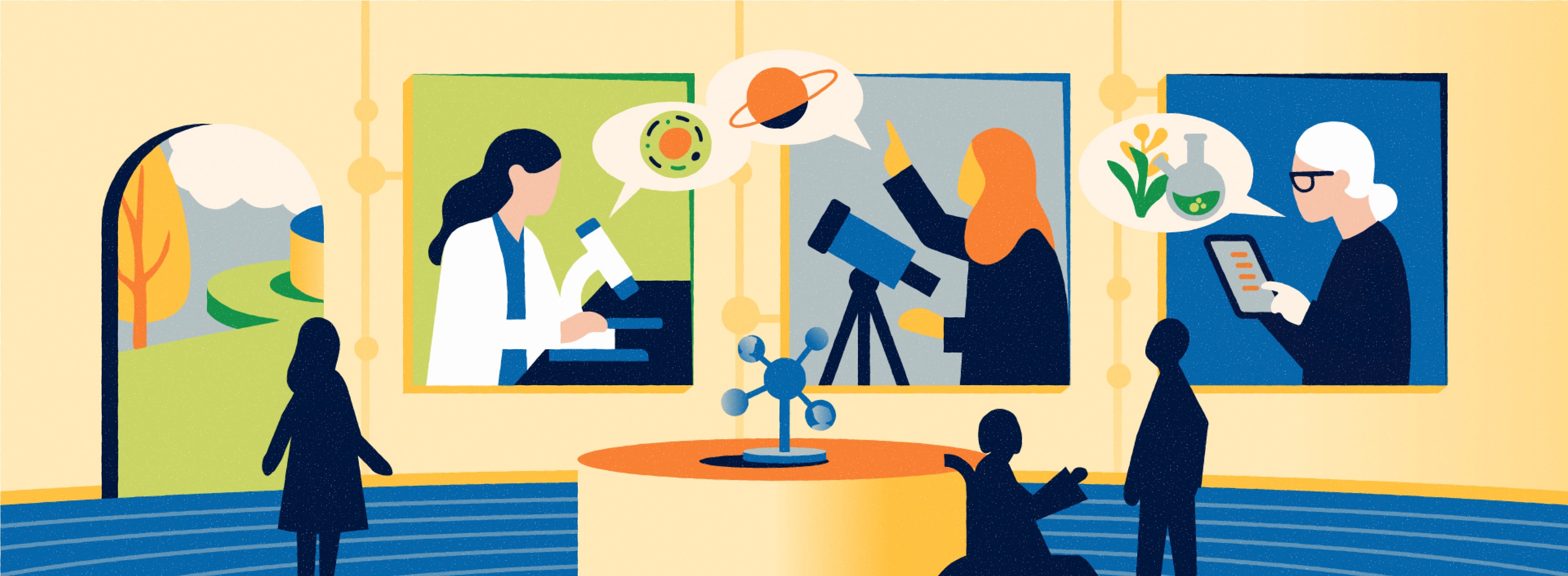
Subject to the mobilisation of the necessary resources, we also hope to develop **Weaving Life**, a major exhibition on biodiversity, climate change and fragile ecosystems. It would explore the interdependence of living systems and the ways in which climate change is disrupting ecological balances, while providing a basis for educational resources and public engagement activities.
Another priority is to take the Museum beyond the screen. Exhibitions could be activated through events at UNESCO Headquarters, round tables with partner institutions, physical installations, webinars and live conversations with the scientists, artists and contributors featured on the platform.
We are also developing adaptable and printable formats so that museums, schools and science clubs can use the exhibitions in their own spaces. The ambition is for each exhibition to become the starting point for a wider programme of education, dialogue and international cooperation.
The project responds to a global challenge: ensuring that reliable scientific knowledge is accessible to all as a public good, at a time when misinformation spreads widely and public trust in science continues to be tested. Can a virtual museum genuinely play a role in rebuilding that trust, or does it risk preaching to the choir?
That risk exists, and no platform can rebuild trust in science on its own. The Museum’s contribution is to make scientific knowledge more accessible without oversimplifying it.
Science is complex. It develops through observation, debate, revision and uncertainty, and it is produced within particular historical, social and cultural contexts. By presenting it through human stories and perspectives from different regions, the Museum can make those processes more visible and help audiences understand not only what we know, but how that knowledge has been constructed.
The aim is not to make science appear simpler than it is, or to ask people to accept it unquestioningly. It is to make it possible to engage with its complexity, to recognise its relevance to our lives and to understand why access to reliable knowledge matters.
The Virtual Science Museum was born in a context where AI is simultaneously reshaping how scientific knowledge is produced, shared and consumed. Five years from now, what could this virtual science museum look like, and what will it even mean to be a science museum?
Five years from now, I hope the Museum will have continued to develop through new exhibitions, educational resources and contributions from a wider range of museums, universities, scientists, artists and educators. I would also like to see some of its content used beyond the platform, through public events, physical installations and activities adapted by partner institutions.
A virtual museum cannot reproduce the encounter with a real object or the experience of sharing a physical space. What it can do is connect knowledge, collections and perspectives from different parts of the world, reach audiences who may not have access to a science museum and allow its content to evolve as scientific knowledge develops. The digital and physical dimensions can therefore complement one another.
Artificial intelligence will probably influence how visitors search, navigate, translate and interact with content. However, technology should remain a tool rather than define the Museum itself. Any use of AI would need to be transparent and remain subject to human editorial judgement.
For me, a science museum in the twenty-first century should reflect the fact that science is constantly evolving and closely connected to society. Its role is to make scientific knowledge accessible and engaging, while also helping audiences understand its complexity, its contexts and the processes through which it is produced.
Interview by Benjamin BENITA
MORE
Virtual Science Museum: https://www.unesco.org/en/virtual-science-museum
Isis Le Bas: LinkedIn
Yannick Lintz: Reinventing the Guimet

You are President of the Guimet – French National Museum of Asian Arts, one of the world’s largest museums of Asian art outside the Asian continent, with approximately 60,000 works and multidisciplinary teams covering conservation, research, mediation and programming. Before taking over the presidency of the Guimet, y…
400 Tech Specialists, 100 Historians, 2 Years, One Vision: How China's Deji Art Museum Is Redefining the Visitor Experience

We had the privilege of meeting Ms. Lin AI, Director of the Deji Art Museum in Samarkand, during the International Conference on the Future of Museums organized by UNESCO in November 2025, in which we took part (see the link at the end of this article). Ms. AI graciously agreed to be interviewed for MuseumWeek…